
Did You Know Millions of Adults Could Benefit from Hearing Aids?
Hearing is one of those things many people do not think about until it starts to change. At first, the signs can be subtle. You may turn the TV volume up a little higher than usual. You may ask people to repeat themselves more often. You may notice that restaurants, family gatherings, or group conversations feel more tiring than they used to.
For many people, hearing loss happens gradually. Because the change can be slow, it is easy to adjust without realizing how much you are missing. You may begin reading lips without noticing it. You may avoid noisy environments. You may laugh along in conversations even when you did not catch every word. Over time, these small adjustments can become part of daily life.
But hearing loss is common, treatable, and worth addressing.
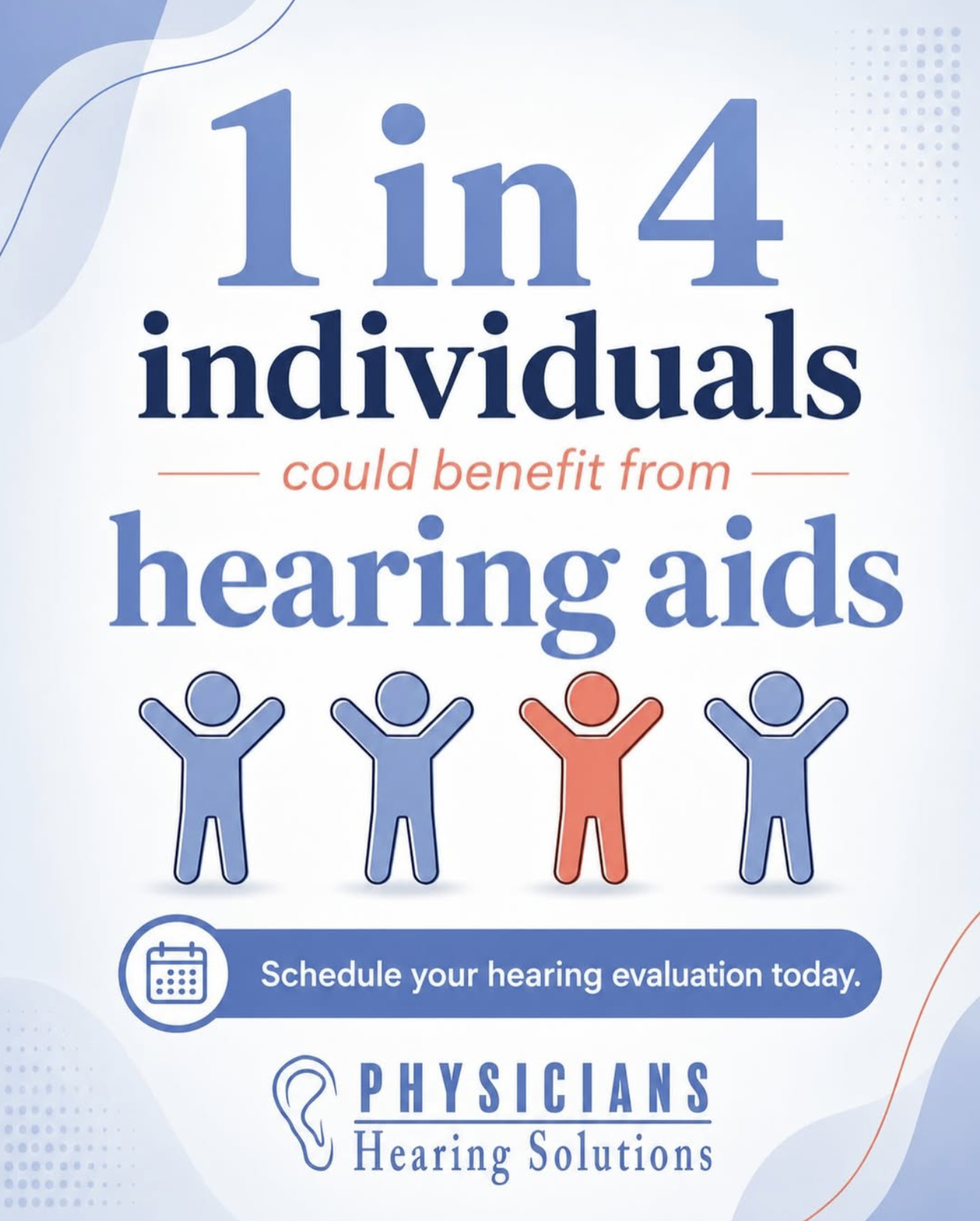
According to the National Institute on Deafness and Other Communication Disorders, about 37.5 million U.S. adults report some trouble hearing, and 28.8 million U.S. adults could benefit from using hearing aids. Yet only 1 in 4 adults ages 20 and older who could benefit from hearing aids has used them.
That means many people are living with hearing challenges that could potentially be improved with the right care, support, and technology.
At Physicians Hearing Solutions, we are here to help you better understand your hearing health and find solutions that fit your lifestyle.
Hearing Loss Is Often Gradual
Hearing loss does not always happen suddenly. In many cases, it develops slowly over years. This is one reason people often wait before seeking help. They may not notice the change right away, or they may assume it is just a normal part of getting older.
Age-related hearing loss is common. The National Institute on Aging notes that hearing loss affects about one-third of older adults, and the chance of developing hearing loss increases with age. Hearing loss can also be caused by loud noise exposure, illness, genetics, certain medications, injury, earwax buildup, and other ear-related conditions.
Because hearing loss can happen gradually, friends and family members may notice it before the person experiencing it does. A spouse may mention that the TV is too loud. A child may notice that conversations need to be repeated. A friend may realize that someone is withdrawing from social plans because group settings have become frustrating.
These moments can be easy to brush off, but they can also be important clues.
Common Signs You May Benefit from a Hearing Evaluation
Not all hearing loss feels the same. Some people have trouble hearing high-pitched sounds. Others hear sound but struggle to understand words clearly, especially when there is background noise. Some people feel like everyone around them is mumbling.
You may benefit from a hearing evaluation if you notice any of the following:
You often ask people to repeat themselves
You feel like others are mumbling
You hear people talking but cannot always understand the words
You turn up the TV, radio, or phone volume higher than others prefer
You have trouble following conversations in restaurants or crowded rooms
You avoid social situations because listening feels tiring
You struggle to hear on the phone
You miss doorbells, alarms, timers, or other everyday sounds
You have ringing, buzzing, or hissing in your ears
Family members or friends have mentioned concerns about your hearing
One of the most common signs is difficulty hearing in background noise. Many people with hearing loss can manage well in a quiet room, especially one-on-one. But when multiple people are talking, music is playing, or dishes are clinking in a restaurant, speech can become much harder to follow.
That does not mean you are not paying attention. It may mean your ears and brain are working harder than they should have to.
Hearing Is About More Than Volume
A common misconception is that hearing loss simply means sounds are not loud enough. In reality, hearing is also about clarity.
Someone with hearing loss may hear that another person is speaking but may miss certain speech sounds. Words can blur together. Consonants like “s,” “f,” “th,” “p,” and “t” can become harder to distinguish. This can make conversations feel confusing, especially when there are competing sounds nearby.
That is why turning up the volume does not always solve the problem. Louder sound is not always clearer sound. Hearing aids are designed to do more than amplify everything. Today’s hearing technology can help make speech more accessible, reduce listening strain, and support communication in a variety of environments.
Why People Often Wait to Get Help
Even when people suspect they have hearing loss, many delay getting care. Some people feel embarrassed. Others worry that hearing aids will be uncomfortable, noticeable, or difficult to use. Some assume their hearing is “not bad enough yet.” Others simply get used to missing parts of conversations.
But waiting can come with a cost.
Hearing difficulties can affect communication and participation in everyday life, including work, education, civic activities, and social connection, according to the CDC’s National Center for Health Statistics.
When hearing becomes harder, people may start pulling back without realizing it. They may skip dinners out, avoid phone calls, or stop participating in group conversations. Over time, this can affect relationships, confidence, independence, and quality of life.
Getting your hearing checked does not mean you are committing to hearing aids that day. It simply gives you information. It helps you understand what is happening and what options are available.
The Everyday Impact of Better Hearing
Hearing aids can make a meaningful difference in daily life. For many people, the benefit is not just hearing more sound. It is reconnecting with the moments that matter.
Better hearing may help you:
Follow conversations with less effort
Enjoy time with family and friends
Participate more confidently in social settings
Hear children or grandchildren more clearly
Communicate better at work
Feel more comfortable in restaurants, stores, and gatherings
Reduce the frustration of constantly asking people to repeat themselves
Feel more connected to the world around you
Many people do not realize how much energy they have been using to listen until hearing becomes easier. When you are constantly straining to understand speech, your brain has to work harder to fill in the gaps. This can make conversations feel exhausting.
With the right hearing support, listening can feel less like work.
Hearing Health and Overall Wellness
Hearing health is closely connected to overall wellness. While hearing aids are not a cure for every health concern, research continues to show that hearing loss should not be ignored.
The National Institute on Aging reported findings from a study showing that hearing aids slowed cognitive decline in older adults at higher risk, with the group receiving hearing aids showing an almost 50% reduction in the rate of cognitive decline compared with the health-education group.
This does not mean hearing aids prevent all cognitive issues, but it does reinforce an important point: hearing care is health care.
When you hear better, you may communicate more, participate more, and stay more engaged with the people and activities around you. Those daily interactions matter.
Modern Hearing Aids Are Smaller and Smarter Than Many People Expect
If your idea of hearing aids comes from devices used decades ago, you may be surprised by how much technology has changed.
Modern hearing aids are often discreet, comfortable, and highly customizable. Many are designed to work with smartphones and other devices. Depending on the model and your needs, hearing aids may offer features such as:
Rechargeable batteries
Bluetooth connectivity
Noise reduction
Directional microphones
Smartphone app controls
Customized programming
Automatic adjustments for different environments
Tinnitus support features
Comfortable, nearly invisible designs
The goal is not just to make sounds louder. The goal is to help you hear better in real life, whether you are at home, at work, in the car, outside, or spending time with loved ones.
Hearing Aids Are Not One-Size-Fits-All
Every person’s hearing is different. That is why a proper hearing evaluation is so important.
Your hearing needs may depend on:
The type of hearing loss you have
The severity of your hearing loss
Your ear anatomy
Your daily routine
Your work environment
Your social life
Your comfort with technology
Your budget
Your personal preferences
Someone who spends most of their time in quiet environments may need different support than someone who frequently attends meetings, restaurants, church services, concerts, or family gatherings. A person who uses a smartphone often may want different features than someone who prefers a simpler device.
At Physicians Hearing Solutions, the goal is to match your hearing care to your life, not force your life to fit a device.
What to Expect During a Hearing Evaluation
A hearing evaluation is a simple and informative first step. It helps identify whether hearing loss is present, what type of hearing loss you may have, and what solutions may be appropriate.
During a hearing appointment, you may discuss:
Your symptoms
Your medical and hearing history
Situations where hearing feels difficult
Noise exposure history
Ear-related symptoms such as ringing, fullness, or dizziness
Your communication goals
Testing may evaluate how well you hear different tones and how clearly you understand speech. The results help create a clearer picture of your hearing health.
If hearing aids may help, your provider can explain your options, answer questions, and recommend technology based on your hearing needs and lifestyle.
When Should You Schedule a Hearing Test?
You do not need to wait until hearing loss feels severe. In fact, earlier evaluation can make it easier to understand your hearing and take action before communication becomes more difficult.
Consider scheduling a hearing test if:
You have noticed changes in your hearing
Loved ones have expressed concern
You are frequently asking people to repeat themselves
You avoid noisy places because hearing is difficult
You have ringing or buzzing in the ears
You have a history of loud noise exposure
You are over 50 and have never had a baseline hearing test
You already wear hearing aids but feel they are not helping enough
A hearing test can give you answers. Sometimes the issue may be hearing loss. Other times, symptoms may be related to earwax, middle ear problems, infection, or another treatable condition. The important thing is to find out.
Small Changes Can Make a Big Difference
Many people who begin using hearing aids describe the experience as rediscovering sounds they did not realize they were missing. Birds outside. A turn signal in the car. A loved one speaking from another room. The softness of a child’s voice. The details in music. The ease of joining a conversation without constantly guessing.
Better hearing can change ordinary moments.
It can make dinner less frustrating. It can make phone calls easier. It can make family gatherings feel more enjoyable. It can help you feel more present, more confident, and more connected.
You Deserve to Hear What Matters
Hearing loss is common, but it does not have to be ignored. If you have been wondering whether hearing aids could help, the first step is not a commitment. It is a conversation.
At Physicians Hearing Solutions, we are here to help you understand your hearing health, explore your options, and find solutions that fit your lifestyle.
Whether you are just starting to notice changes or have been struggling with hearing for years, support is available.
Do not wait to find out what you have been missing. Schedule a hearing evaluation with Physicians Hearing Solutions today and take the first step toward clearer, more confident hearing.